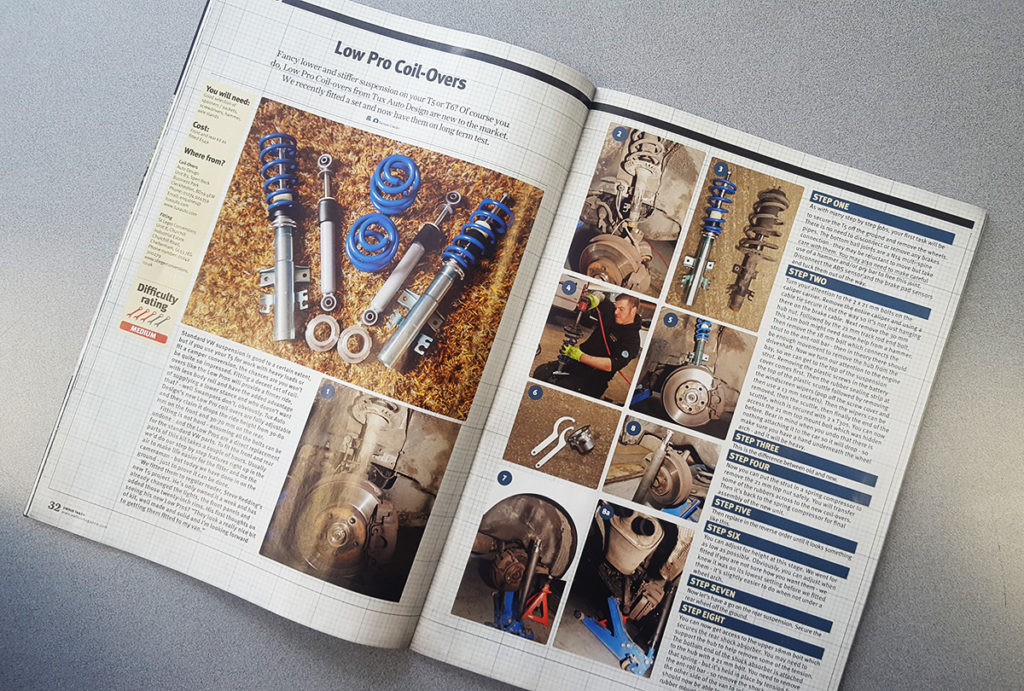
VW Bus Magazine Review our Low Pro Coilovers & Fitting Guide

Written by Simon Cooke in 2019

Fancy lower and stiffer suspension on your T5 or T6? Of course you do, Low Pro Coil-overs from Tux Auto Design are new to the market. We recently fitted a set and now have them on long term test.

You will need: Good selection of spanners / sockets, screwdrivers, hammer, axle stands

Difficulty rating: 3

Standard VW suspension is good to a certain extent, but if you use your T5 for work with heavy loads or fit a camper conversion, the chances are you won’t be quite so impressed. Fitting a decent set of coil-overs like the Low Pros will provide a firmer ride, with less body roll and have the added advantage of supplying a lower stance and who doesn’t want that? – well Swampers don’t, obviously. Tux Auto Design’s new Low Pro Coil-Overs are fully adjustable and they claim it drops the ride height from 30-80 mm on the front and 30-70 mm on the rear.

Fitting is not hard – assuming all the bolts can be undone – and the Low Pros are a direct replacement for the standard VW parts. To fit the front and rear parts of this kit takes a couple of hours. Usually we’d do our step by step features right up in the air to make life easier for the fitter and me the cameraman – but today we have done in on the ground – just to prove it can be done.

We fitted them to regular reader, Steve Redding’s new T5 project. He’s only owned it a week and has already changed the lights, the front panels and added those twenty-inch rims. His first thoughts on seeing his new Low Pros? “They look a really nice bit of kit, well made and solid and I’m looking forward to getting them fitted to my van.”

He fitted them on their lowest setting – and can’t see a good reason to ever adjust them again. Having fitted them he went and drove a few laps to get them to bed in. “I’ve just driven around our estate and there are some really bad roads around here and it felt good, a nice ride, but still with a bit of give in them,” reported Steve. And more importantly his Chihuahua will be delighted as he can now get in and out of the van without needing a helping hand! Fast forward 6 weeks when Steve has had time to get used to his new suspension and he reports that his initial positive experience still stands – they offer a firm but not too firm ride, a good low stance, although he’s encountered no problems with speed bumps, and he’s got no problem driving his T5 on a daily basis. And when I reveal the price to him he reckoned that they are an absolute bargain and something he’d certainly be recommending to his fellow VW enthusiasts.

Step 1

As with many step by step jobs, your first task will be to secure the T5 off the ground and remove the wheels. There is no need to disconnect or remove any brakes pipes etc. The bottom ball joints are a N14 multi-spine connection – they may be reluctant to move but take care with them. You may also need to make careful use of a hammer and/or pry bar to free this joint. Disconnect the ABS sensor and the brake pad sensors and tuck them out of the way.

Step 2

Turn your attention to the 2 x 21 mm bolts on the caliper carrier. Remove the entire caliper and using a cable tie secure it out the way so it’s not just hanging there on the brake cable. Next remove the 30 mm hub nut. Followed by the 21 mm track rod end bolt. This 21m bolt might need some help from a hammer. Then remove the 18 mm bolt which connects the strut to the ant-roll bar – then in theory there should be enough movement to remove the hub from the driveshaft. Now we turn our attention to the engine bay, so we can get to the top of the suspension strut. Removing the plastic screws in the battery cover comes first. Then the rubber sealing strip at the top of the plastic scuttle followed by removing the windscreen wipers (pop off the screw cover and then use a 13 mm sockets). Then the wipers can be removed, then the scuttle, then finally the end of the scuttle, which is secured with 2 x T30s. You can now access the 21 mm top mount bolt which was hidden before. Bear in mind when you undo that there is nothing attaching it to the car so it will drop – so make sure you have a hand underneath the wheel arch – and it will be heavy.

Step 3

This is the difference between old and new. (see image at the bottom)

Step 4

Now you can put the strut in a spring compressor to remove the 21 mm top nut safely. You will transfer some of the rubbers across to the new coil-overs. Then it’s back to the spring compressor for final assembly of the new unit.

Step 5

Then replace in the reverse order until it looks something like this.

Step 6

You can adjust for height at this stage. We went for as low as possible. Obviously, you can adjust when fitted if you are not sure how you want them – we knew it was on its lowest setting before we fitted them – it’s slightly easier to do when not under a wheel arch.

Step 7

Now let’s have a go on the rear suspension. Secure the rear wheel off the ground.

Step 8

You can now get access to the upper 18mm bolt which secures the rear shock absorber. You may need to support the hub to help remove some of the tension. The bottom end of the shock absorber is attached to the hub with a 21 mm bolt. You need to remove that spring – but it’s held in place by tension from the ant-roll bar – so remove the shock absorber from the other side of the van to release that tension. You should now be able to remove both springs and their rubber mounts.

Step 9

Can you guess which are the new shocks and springs ?

Step 10

Assemble the new springs and locate them back in place, followed by the new dampers. Of course, you can adjust the ride height on the rear at this point – again we went for its lowest setting.

Step 11

These are the before and after photos, although ‘after’ is a relative term as they will undoubtedly settle after a few miles have been put on them.

We fitted the Low Pros on their lowest setting – and can’t see a good reason to ever adjust them again. Having fitted them Steve went and drove a few laps of the vicinity to get them to bed in and gave us his initial report. “I’ve just driven around our estate a few times and there are some really bad roads around here, it felt good, a nice ride, but still with a bit of give in them.” More importantly his Chihuahua will be delighted as he can now get in and out of the van without needing a helping hand!

We left Steve to get used to his latest modification and returned some six weeks later for an interim report. Now Steve has had time to get used to his new suspension he reported that his initial positive experience still stands – “they offer a firm, but not too firm ride, a good low stance,  I’ve encountered no problems with speed bumps and I’ve got no problem driving my T5 on a daily basis. And when I revealed the price to him, £549, he reckoned they were an absolute bargain and something he’d certainly be recommending to his fellow VW enthusiasts.

We will be returning to Steve later in the year for a long-term test report.
How Has Automotive Suspension Evolved?

It’s beyond our imagination that we’ve gone from horse and carriage as the only form of transport to the invention of four-by-fours with luxury leather interiors and automotive suspension. But have you ever wondered how these cars have actually evolved to where they are now? 

In this post, we’ll cover where automotive suspension began, how it has revolutionised driving since it was first created and some of the best technologies to help improve your much-loved car’s performance.


The History of Automotive Suspension 

Believe it or not, the first car was created back in the late 1700s; however, this was a steam-powered car which had to be self-propelled, so it’s safe to say that no useful suspension was involved there! So, let’s face it, these high-tech cars wouldn’t exist if it wasn’t for the invention of the first official car (The Motorwagen), powered by an actual engine and gasoline, invented by the famous Karl Benz in 1886. Bet you didn’t think that the lavish Mercedes-Benz motors you see driving around today date back to the 19th century!

Even though cars were around as early as they were, it wasn’t until the early 1900s where suspension became known to drivers. You’re probably wondering how safe the roads really were back then, but this is exactly why automotive suspension didn’t become a thing until the 20th century! The first automobile featured front coil springs and shock absorbers which didn’t require any lubrication like the original leaf springs did. It might be hard to believe, but this was an improvement from what people were out on the road in before-hand. The coil springs made it a painful enough journey, let alone the leaf springs that were used before-hand! 

However, as basic as coil springs were, putting them together with state-of-the-art shock absorbers was another story! By 1931, the first Mercedes-Benz 170 with a fully industrial swing axle suspension was created which was when ride comfort and safety was born, and consistent punctures were no more. So now it makes sense where Mercedes gets their reputation for exceptionally comfortable and safe vehicles from!


How Has Suspension Technology Revolutionised Driving?

Shock Absorbers & Struts

You might be wondering how something created over a century ago is still being used today in our supercharged motors, but trust me, they have been modified a tonne since then! The first shock absorbers were pretty much a lever with a piece of rubber between the frame and leaf spring and were known to provide a “magnificent” ride – doesn’t sound too hopeful, does it?

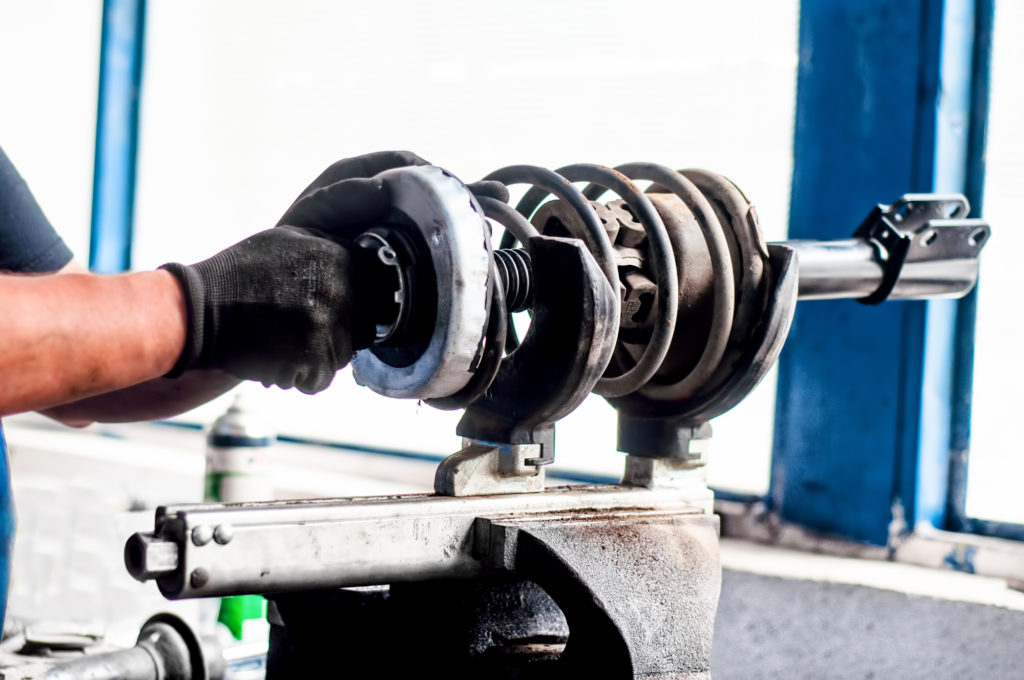
Whether your car has shock absorbers or struts (similar to shocks but used on front-wheel drives) to help improve automotive suspension, you’ll find them bolted inside a coil spring. The most technically advanced shock absorbers will be what are in your car today with the main goal to prevent your tyres leaving the ground, giving the most effortless and controlled journey you’ll ever have. Gone are the days of bouncing down the country roads like a rabbit.

Shocks today feature small holes to allow oil through, dampening the motion of your tyres to provide that well-needed lubrication for a smooth ride. They also include valves, electronics and magnetism so whether you’re a racer at heart or a more leisurely driver, they’ll be sure to meet your needs! If you’re a sports car fanatic, you’ll love to hear that some cars feature sport mode buttons that you can simply press to help avoid those interruptions on the road. 

As much as technology has revolutionised driving over time, some of the first cars even used electronic sensors in the bumper to adjust the ride from hard, medium or soft depending on the condition of the road, and this innovation is still being used in models today so you won’t even have to think about comprehending damage from the beastly pothole! 


shock-absorber-being-adjusted-in-a-car-workshop


Air Suspension

As ground-breaking as air suspension is, it’s mainly only used in sports utility vehicles (SUVs) because of its high costs. So if you’re wondering whether your family seven-seater car has it, the answer is definitely a no! You might have been thinking that the technology in vehicles couldn’t be improved any further than they already have been, but you’re wrong. 

As ingenious as shock absorbers are, they’re just not enough for top-speed SUVs going at full tilt, so this is when air suspension revolutionised sport vehicles. Steel springs were replaced with firm airbags which can be adjusted with a compressor depending on driver preference. If you thought that was as high-tech as it got, some cars even have built-in GPS so the suspension is automatically adjusted when you’re at the next corner! Clever, right?


What Technologies Can Improve My Car’s Suspension?

Active Curve Titling

If you’re a motorcyclist owner, you might think curve tilting is the norm, but it certainly isn’t for car owners! However, a technology that could change your mind is active curve tilting, first created in the 2015 Mercedes-Benz S65 AMG Coupe. The model uses an acceleration sensor with a camera which predicts corners and uses air suspension to tilt the car. This might not increase the performance of your vehicle, but it most definitely will improve its comfort!

Hydraulic Roll Control

Known to Audi owners as Dynamic Ride Control, Hydraulic Cross-Linked Suspension sends fluid to the opposite side of the car, rather than steel antiroll bars which get in the way and can impact your car giving you that smooth ride that you want!

Magnetic Dampers

Remember when we mentioned that well-needed lubrication for your shock absorbers? Well, magnetic dampers are pretty much a version of a shock absorber, and by varying their electric current through fluid containing iron, they adjust their stiffness in response to the road’s conditions.


Is There a Future For Automotive Suspension?

According to The Engineer, a  medical engineering student from Lancaster University has developed a never-seen-before method of improving automotive suspension even further. The 20-year-old’s invention features a delay in compression and expansion and is said to be suitable for use in pretty much everything that involves a shock absorber or damping system! So could this be the next cutting-edge technology? We are definitely excited to see where it goes!


Where Can I Find More Information On Improving My Car’s Suspension?

At TUX Auto, we understand how important both the interior and the exterior of your vehicle is when it comes to suspension, so for more information about what wheels or coilovers will be best, visit our website or call us today on 01274 864457.

Unleash the Beast; Coolest U.K Roads to Explore this Summer

One of the best feelings you can ever experience is driving down an amazing road, feeling it through the car, away from the traffic lights and speed cameras. Without the constant traffic jams, with the open road in front of you, that feeling of sheer freedom is incredible.

However, despite what we see in the movies, you don’t need to travel the US or go over to Germany’s famous Autobahn to experience this! The UK actually has a brilliant selection of roads for you to just let go and have some fun on.

So, in order to help you know where to go, we’ve put together a list of some of our favourite routes. Jump behind the wheel, head on over to these astounding locations and just let your hair down!

The Peak District Circuit – Hope, Edale & Castleton

Starting off strong, we have roughly 11 miles of postcard-worthy scenery leading you in a circuit through the gorgeous Peak District. Easily accessible from places like Donington Park due to being so close to the M1, the Peak District Circuit offers a wonderful first step into enjoying the Great British scenery and roads.

By taking a trip around the Peak District Circuit, you’ll get to see historical features and natural beauties such as the large caverns at Castleton. On top of that, Peveril Caste also stands tall above Castleton itself, meaning that you can easily take a pitstop to enjoy the local history and culture.

Cheddar Gorge

If you wanted something even more beautiful than the Peak District, where you can just get lost in the majestic landscapes rather than drive for extended periods of time, then Cheddar Gorge is perfect for you! Coming in at just 3.6 miles, it is definitely the shortest route on this list, but the surroundings more than make up for it!

Widely considered a perfect drive for supercars, this short route will have you gawking at the natural rock formations whilst you enjoy the twists, turns and hairpins that await you. Carved by the melting of the Ice Age, Cheddar Gorge is the perfect place to lose yourself in the road as you burrow roughly 500 feet into rocks and cliffs. There’s even a huge cave system for you to explore whilst you’re there.

The Cotswolds

Next up, we’re jumping right back to long drives of sheer bliss with the 92-mile long route through the Cotswolds. Mixing both expansive straights and outstanding bends with stunning views and a large number of empty roads, this route offers one of the best experiences you could find in the UK.

Add to this the fact that the entire area is known for being one of the most romantic places in Britain and you have the perfect weekend getaway for you and your four-wheeled lover (and your life partner could come too).

The Midlands Circuit

The final route we wanted to mention is a 173 miles round trip! The Midlands Circuit takes just over 5 hours to complete, so you’ll probably want to stop partway through, even if the gorgeous views and pristine roads are still beckoning you to keep going (and they will be). Luckily, this route features a whole host of activities for you to enjoy away from the steering wheel.

With everything from powerboating to hiking as well as exploring underground cave systems, the Midlands Circuit is an unforgettable experience, both on and off the road. Oh, and once you’ve finished the route, you could easily hop across to the Donington Park race track for one more bit of fun, or bring everything full circle and take the Peak District Circuit for a spin once again!

Hit The Road The Right Way

So there you have it; four elegant routes that you can take your car down and really feel as though you are part of the road! Time to get out there and enjoy yourself.

But if you really want the best experience you can get, the performance and style improvements our alloy wheels will  give your car can only make it better! So why not take a look at our Stuttgart, Riviera and LMR alloy wheels today and give your car that extra sense of fun!

Why You Should Choose Alloys Over Steel Wheels

When it comes to your car, it has long been said that the outside hooks a driver and the inside is what finally makes you fall in love with it. We completely agree with this ideology, and we know that first impressions are key to any driver’s experience with their car.

That’s why we put so much effort into our alloy wheels; we want that first impression after they are fitted to be one of sheer awe. On top of that, a good set of alloys can turn heads. So that means the first impression that anyone has of your car must be the best possible.

However, as wheels are one of the focal points of a car, we need to talk about the different types of wheels that you can get. The two most common types of wheels are steel and alloy wheels. Of these two, alloy wheels are definitely the most recommended, and in this article, we wanted to let you know why that is!

So, let’s take a look at why you should choose alloy wheels over steel wheels.

What Is An Alloy Wheel?

To begin with, it’s important to understand the key difference between alloy wheels and steel wheels; how they are manufactured.

Whilst steel wheels are made from standard metal, alloys are made from a mixture of different metals, combined to create a new material. For example, you may combine aluminium or magnesium with other metals to create the final material for an alloy wheel. Due to this mixture of metals in an alloy wheel, they can sometimes be referred to as Mag Wheels.

In order to properly mix the metals that make up this alloy material, we use casting or forging, although there are other methods, such as gravity casting.

This allows alloy wheels to be both lighter and more durable than steel wheels, already showing you the benefit of having them. There’s a reason why so many car manufacturers are now selling cars with alloy wheels, even if they aren’t exactly attractive ones.

What Are The Advantages of Alloy Wheels?

We’ve already briefly touched upon the fact that alloy wheels are better for weight and durability, but those aren’t the only benefits and advantages of alloy wheels over steel wheels.

Aesthetics

Thanks, in part, to the production process of alloy wheels, we are able to create far more intricate and exciting styles for the wheels when compared to steel wheels. In fact, the manufacturing process even allows us to create custom designs, meaning that alloy wheels are far better for the overall style of your vehicle.

Performance

This comes back to the weight of the wheel; because alloy wheels are significantly lighter than steel wheels, they actually give you a performance boost. However, it’s not only in the way you are probably thinking.

Yes, it would help with acceleration, as the total weight of the car is lower. But, using alloy wheels over steel wheels actually helps with fuel economy, braking and overall handling.

If you keep in mind that roughly a 10% reduction in weight equates to around a 7% improvement in fuel economy, whilst also putting less strain of the different sections of the car, you can instantly see why alloy wheels are the better long term option.

Corrosion Resistance

The final aspect that really puts them far above steel wheels is the fact that the alloy they are made out of is far more resistant to both corrosion and rust. Due to the way in which alloy wheels are manufactured, they are able to keep their shine and performance enhancements intact for substantially longer than steel wheels.

Therefore, you can rest assured that, no matter how many shows and meet-ups you go to, your car’s alloy wheels will remain in peak condition.

Give Your Car The Best It Can Get

Alloy wheels are definitely the best option for your car, with benefits and advantages including improved performance and better corrosion resistance. Therefore, we would highly recommend that you look to replace your steel wheels with a set of alloys as soon as possible.

Why not take a look at our range of Stuttgart, LMR and Riviera alloy wheels to find the perfect style for you and your car? Or check out our stockist list to find the nearest place to get yourself some amazing alloy wheels!

SUBSCRIBE TO OUR TUX AUTO NEWSLETTER